by Chris Alarie
That football is the most popular sport in America and that the NFL is the most popular professional sports league are indisputable facts. This is a frequent source of consternation for me because, while I am certainly a football fan, I find it to be a vastly inferior sport to both baseball and basketball and believe that the NFL is one of the most onerous institutions in all of sports. Of course, the reason for football's dominance are myriad—from the primal appeal of the sport's violence to the relatively short season and once weekly games to the sport's particularly good fit for gambling and fantasy leagues—but there is one key factor that seems to have been overlooked: football's comparatively lesser engagement with advanced statistics.
Both baseball and basketball have been embroiled for years—or decades, in the case of baseball—in debates about the merits and value of advanced statistical methods of quantifying and evaluating the performance of players and teams. These debates often divide along generational lines, with younger writers, fans, and executives generally tending to lend greater credence to these advanced statistics than their older peers. And rather than offer a defense of one approach or the other,1 I'd just point out that these debates are essential parts of the fabric of both MLB and the NBA. Football, however, has mostly managed to avoid this debate and, really, the encroachment of advanced statistics almost entirely.
Indeed, when ESPN tried four years ago to introduce an advanced football statistic titled QBR, it was roundly ignored and routinely mocked. It exists now primarily as a means for other sports media organizations to criticize the "Worldwide Leader". But beyond reflecting somewhat poorly on Disney's otherwise impenetrable sports behemoth, the failure of QBR further serves to demonstrate football's immunity to having advanced stats as a part of the general discourse surrounding the sport. QBR's flawed analysis and laughable conclusions is a larger part of the NFL media and fan landscape than far better and far more useful advanced statistics such as Football Outsiders' DVOA. Often times the debate surrounding advanced stats is reduced to "numbers" vs. "the eye test"; in football, "the eye test" reigns supreme.
The question implicit in this is: why doesn't the majority of football fans care about advanced statistics? While I wouldn't claim to fully explain it, I can hazard a few guesses. Partly it is because football is so much less about individual achievements than baseball and basketball and much of advanced statistics focuses on the performance of individual players. But even still, there are advanced stats (such as the aforementioned DVOA) that focus on team performance and have not gained much traction among the mass of football fans. Perhaps it is a result, in part, from football's militaristic symbolism2 and borderline fascistic obsession with the strength, unity, and secrecy of individual franchises and the league as a whole. The NFL is well known for its paranoid credo, "Protect the Shield". And, as Tim Kawakami frequently observes, NFL fans, more than fans of any other sport, have an extreme loyalty to their franchises and owners over players or even coaches. And the paranoia3 and gamesmanship of NFL coaches is legendary. So perhaps advanced stats, which ostensibly peel back the curtain of of the sport and offer a deeper understanding of why teams and players succeed or fail, are, to NFL fans, the proprietary realm of the overlords running the teams and not the business of us plebes in the general sporting public. Another possible explanation is that the dominance of fantasy football—which traffics almost entirely in traditional stats as opposed to advanced stats—has kept all but the most dedicated fans uninterested in these more complicated statistical analyses. Whatever the reasons, it is clear that advanced stats do not have the same place in football discourse as they do in the realms of baseball and basketball. And that lack of advanced stats is part and parcel of the NFL's perhaps confusing dominance in this country.
This is perhaps an oversimplification, but I suspect that the disparity between the NFL and MLB/NBA reflects, in some ways, differences within the culture as a whole. Advanced statistics, and the sports that more directly incorporate them, seem more likely to appeal to intellectual, coastal elites. By contrast, the NFL, with its rejection of advanced stats in favor of more primal, simplified, and traditional notions of sports, seems more likely to appeal to the mass of red state denizens who feel like the coastal elites and the media ignore their concerns and interests. As I said, this is probably not entirely accurate—among other problems, plenty of us coastal intellectuals still watch football. But it seems, at very least, to be of symbolic importance that probably the biggest football fan among American presidents was Richard "Silent Majority" Nixon while Barack Obama is famously obsessed with basketball. And it is worth noting that the same analytically inclined media that dominates baseball and basketball has been unable to predict or even understand the continued successes of Donald Trump's presidential campaign.
In this somewhat convoluted metaphor, the baseball and basketball focused, pro-analytics crowd is the coastal, media-saturated segment of the population arguing in increasingly minute, esoteric detail about the various discrepancies between Hillary Clinton's complicated financial regulation plans and Bernie Sanders's promise to "break up the banks!"4 The more conservative, anti-advanced stats faction of the baseball and basketball world is analogous to the conservative intellectuals futilely decrying Donald Trump's conservative bona fides in the pages of The New Republic. In the meantime, the remaining hordes are actively defying both sides of these debates by watching football and pledging their intention to vote for Donald Trump. This is not to say that all football fans are Trump supporters or vice versa, but there is clearly a similar dynamic playing out in the realms of sports and politics.
1 Of course, like any good liberal, I almost neurotically try to split the difference between the two camps in my personal feelings toward the subject.↩
2 George Carlin's famous routine about the difference between baseball and football remains as true as ever.↩
3 There's that word again.↩
4 Clearly, I fall into these camps.↩
Chris Alarie is Spectacular Editor-in-Chief of Uncanny Valley Magazine.

Showing posts with label baseball. Show all posts
Showing posts with label baseball. Show all posts
Sunday, January 31, 2016
Saturday, January 2, 2016

Friday, September 25, 2015
Remembrances of Yogi Berra
by Steve Alarie
I remember when I met Yogi Berra in Walnut Creek in 1964. My dad had just bought me an icea cream cone at the Walnut Bowl. The ice cream fell off the cone when I licked it and it fell on the ground. Yogi was walking by me and said, "Tough shit, kid." And then I started crying because his big ears scared me. My older brother slugged my arm.
Wait, it wasn't 1964. He was in Walnut Creek during the World Series in 1962. Yeah, now I remember. It was Hokey's Burgers. I was choking on a french fry and he laughed at me. My face turned blue and he said, "Knock it off, kid."
I remember when I first met Yogu Berra. It was in Walnut Creek in 1962. My dad had just bought me an ice cream cone. I think it was lime sherbet from the Walnut Tree Restaurant. I was walking out of the restaurant and, with my first lick, accidentally knocked the ice cream off the cone. Of course, I started crying. Berra walked by and said, "Stupid kid, stop crying." And then he slapped me on the side of the head and kept walking. You should have seen the size of his ears!
Actually that was a lie. I never met Yogi Berra.
Steve Alarie found 1647 pennies on the ground last year. He has made almost $1100 dollars this year from collecting cans from the garbage in public parks and taking them to recycling centers.
Thursday, August 20, 2015
The Best Fans in Baseball Can Not Be the Best Fans in Baseball
by Chris Alarie
On Wednesday evening, San Francisco
Giants center fielder Juan Perez made one of the best defensive plays
by any baseball player this season, scaling
the wall to rob a home run from St. Louis Cardinals outfielder
Stephen Piscotty. It was a genuinely amazing catch, something that,
as the Fox Sports Midwest broadcasters mentioned, even the Cardinals
fans acknowledged with polite applause. This reaction was consistent with the
St. Louis fans' cherished distinction as “the
Best Fans in Baseball”.1
As a Giants fan, I found that pleasant, respectful behavior on the
part of Cardinals fans to be incredibly annoying. Indeed, there is
something particularly obnoxious about the falsely modest attitude
the Cardinals fanbase adopts in order to justify and propagate the
“Best Fans” designation. I am not aiming to disseminate or
undermine that designation,2
but rather to try to understand why the attitude of St. Louis fans
seems so hollow and inauthentic.
In his takedown of the Cardinals fans'
“the Best Fans in Baseball” myth, Drew Magary writes: “I
think Yankees fans are horrible people: selfish, arrogant, profane,
and miserable all at once. But at least they don't attempt to hide
their repulsiveness. At least there isn't this deliberate, 'Oh, we're
not like those OTHER fans' fakeness that OOZES from the Cardinals and
their acolytes.” Ultimately, what offends Magary—and, likely,
what offends me, as well—is the inauthenticity in the Cardinals
fans' claims of modesty and civility that lie at the heart of their
“Best Fans in Baseball” title. It reminds me a bit of this
strange, fascinating, rambling article by Marc Yearsley about Guy
Fieri and James Murphy in which he (eventually) makes the argument
that as obviously obnoxious as Guy Fieri is, his obnoxious is
preferable to James Murphy's ostensibly more acceptable cool persona
because Fieri is authentic in his awfulness while Murphy's perceived
coolness is inauthentic. For Magary and many other sports fans, the
overt, authentic offensiveness of Yankees fans (or Red Sox fans or
Dallas Cowboys fans or all Philadelphia sports fans, etc.) is
preferable to the false modesty of Cardinals fans. And I think I
agree with that assessment. While I have a number of qualms about the
contemporary obsession with authenticity, there is something
especially obnoxious to me about the “aw shucks, we're just good,
modest, Midwestern baseball fans” attitude that underlies the
Cardinals fans' claim to being “the Best Fans in Baseball”.
And yet, there must necessarily be a
fanbase that does consist of “the Best Fans in Baseball”. The
Cardinals fans really do have as much of a stake to that claim as any
other fanbase but by the simple fact of acknowledging it, they
undermine their case. There is something eerily self-defeating about
this whole spiraling, postmodern cycle of self-knowledge and
instability. To be “the Best Fans in Baseball” requires that they
do not claim to be “the Best Fans in Baseball” yet to deny the
designation of “Best Fans in Baseball” seems equally as
disingenuous, in an altogether different manner. So there are no
“Best Fans” yet there must be the “Best Fans” but the title
of “Best Fans” is inherently unstable and ceases to be applicable
once it is applied. The whole thing is dizzying.
Chris Alarie is Senior Editor-in-Chief of Uncanny Valley Magazine.
1 In fact, cheering good plays by other teams' players is number one on Will Leitch's nauseating list of “10 Reasons Why Cardinals Fans May Be The Best Fans In Baseball”.↩
2 Both Drew Magary and the excellent Baseball's Best Fans Twitter account have already thoroughly covered that.↩
Chris Alarie is Senior Editor-in-Chief of Uncanny Valley Magazine.
1 In fact, cheering good plays by other teams' players is number one on Will Leitch's nauseating list of “10 Reasons Why Cardinals Fans May Be The Best Fans In Baseball”.↩
2 Both Drew Magary and the excellent Baseball's Best Fans Twitter account have already thoroughly covered that.↩
Monday, July 20, 2015
Contact High and Hitting to All Fields: the San Francisco Giants' Counterintuitive Offensive Success
by Chris Alarie
Two weeks ago, the San Francisco Giants signed an 18 year old shortstop from the Bahamas named Lucius Fox who was ranked by MLB.com as the third best international prospect available in this year's class of free agents. This was notable because the Giants have not been particularly aggressive in signing highly touted international prospects in recent years, unlike the rival Los Angeles Dodgers. Accordingly, one might be tempted to wonder why the Giants bucked their usual strategy in order to sign Fox. A clue might be evident in the MLB.com scouting report on Fox: “On offense, he's known for his ability to put the ball in play, and he can spray the ball to all fields.” The ability to make contact and hit to all fields is a hallmark of a number of the Giants' best hitters and may offer some hint toward the organizational philosophies that have led to three unexpected World Series titles in the last five years.
by Chris Alarie
Two weeks ago, the San Francisco Giants signed an 18 year old shortstop from the Bahamas named Lucius Fox who was ranked by MLB.com as the third best international prospect available in this year's class of free agents. This was notable because the Giants have not been particularly aggressive in signing highly touted international prospects in recent years, unlike the rival Los Angeles Dodgers. Accordingly, one might be tempted to wonder why the Giants bucked their usual strategy in order to sign Fox. A clue might be evident in the MLB.com scouting report on Fox: “On offense, he's known for his ability to put the ball in play, and he can spray the ball to all fields.” The ability to make contact and hit to all fields is a hallmark of a number of the Giants' best hitters and may offer some hint toward the organizational philosophies that have led to three unexpected World Series titles in the last five years.
In recent seasons, Major League Baseball has become something of a three-true-outcomes league, with teams being less concerned with the increasing rate of strikeouts so long as those strikeouts are somewhat mitigated by homers and walks. Over the last five seasons, the Giants have mostly gone against that trend, instead building lineups based around hitters with little power1 but high contact rates and the ability to hit toward all fields. This approach, which manager Bruce Bochy often refers to as “keeping the line moving”, has allowed the team to remain surprisingly productive offensively in recent seasons.
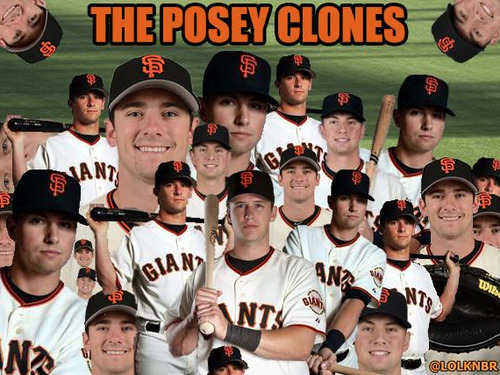
This offensive approach serves the team well in three ways: 1) it mitigates the power-draining tendencies of their home ballpark; 2) it makes them less susceptible to another recent league-wide trend: extreme defensive shifts; and 3) it allows them to find players who may have been undervalued by other teams. In his excellent, recent article about the highly effective Giants' homegrown infield, Grantland's Jonah Keri writes about how the Giants foursome of first baseman Brandon Belt, all-star second baseman Joe Panik, all-star shortstop Brandon Crawford, and third baseman Matt Duffy had never “quite garnered 'elite prospect' status—yet all four have gone on to exceed expectations.” Importantly, a key piece of each player's success is the ability to make contact at a high rate and hit to all fields.2 Perhaps most notable among this foursome is Joe Panik, whose ability to hit to all fields and general resemblance in terms of swing and approach3 to the Giants star and bellweather, Buster Posey, has earned him a nickname as being one of the Clones of Posey.4 Keri describes Panik's unexpected success thusly:
“Panik isn’t just an excellent player; he’s also a great fit for the Giants. As harsh as AT&T Park is on home run hitters, it’s a place that rewards contact hitters. For Panik, who owns the ninth-highest contact rate among MLB’s 162 batting-title-qualified hitters, that’s great news. He also sports baseball’s seventh-lowest swing-and-miss rate and is in the top third among NL hitters for line drive rate. At just 24 years old, five years away from free agency, and still making the league minimum, Panik has become one of baseball’s most valuable commodities.”
A look at Panik's spray chart confirms that he is indeed excellent at hitting balls to all parts of the field, perhaps explaining why he has been so successful as a player who defies the favored three-true-outcomes mold—his “tortoise and the tortoise” home run race with Matt Duffy notwithstanding.
This all-fields approach is not exclusive to the Giants current quartet of infielders. Alien right fielder Hunter Pence is one of the team's only traditional power threats, but much of his effectiveness comes from his ability to hit with power to the opposite field. Former, longtime third baseman Pablo Sandoval is noted for his tendency to swing at and ability to make contact with nearly any pitch. Left field Nori Aoki takes a typically Japanese, inside-out approach to hitting that results in hit scattered all throughout the diamond. Perhaps no hitter exemplifies the Giants' all-fields approach than star catcher Buster Posey. When he is most effective, Posey's approach is to look to drive the ball up the middle of the field with an tendency to take whatever pitches he faces and hit them to the appropriate field, resulting in an ability to hit with power to all fields.

People often mistakenly conflate Oakland Athletics' general manager Billy Beane's moneyball5 approach to team building with a preference for high on-base-percentage and at least moderate power—something akin to the aforementioned three-true-outcomes. But really what Beane was attempting to do was find players with useful skills that were undervalued in the player scouting and acquisition markets, largely to mitigate Beane's relative disadvantages in terms of budget and resources. But now that the three-true-outcomes approach has become something like baseball orthodoxy, teams must look to other undervalued skills in order to gain advantages over their competition. The Giants, lead by vice president and longtime general manager Brain Sabean—who is derisively depicted in Moneyball as being out of touch—seem to have found such an advantage with their unorthodox emphasis on acquiring hitters who can make contact and above average rates and hit to all fields, whether or not they can do so with home run power. While a number of other key factors deserve at least equal credit—from heroic postseason pitching performances to consistently excellent defense to a future hall of fame manager—the Giants have nonetheless managed to become the first baseball dynasty of the 21st century while defying the league-wide offensive trends.
Chris Alarie is Senior Editor-in-Chief of Uncanny Valley Magazine.
1 The 2010 World Series champion team was an exception, as that team's lineup, by the end of the season, was comprised primarily of players with moderate home run power.↩
2 Brandon Belt has become a bit more of a pull hitter in recent seasons, making him the only player occasionally—but not always— susceptible to defensive shifts. But throughout his career, he has been able to hit to all fields.↩
3 And rosy-cheeked-ness.↩
4 The other Posey Clone is backup catcher Andrew Susac.↩
5 So named after the Michael Lewis book and Bennett Miller film about Beane.↩
Subscribe to:
Posts (Atom)